Get Support
040-388-4597
-
 By: admin
 - 0 Comments
 By:
By: Brisbane is undergoing one of the most ambitious urban transformations in its history. With the Cross River Rail reshaping underground connectivity and the Brisbane Metro preparing to move thousands of commuters daily, the city’s infrastructure agenda ahead of the 2032 Olympics is overwhelmingly focused on what gets built. What receives far less attention but arguably delivers equal environmental impact is what gets removed.
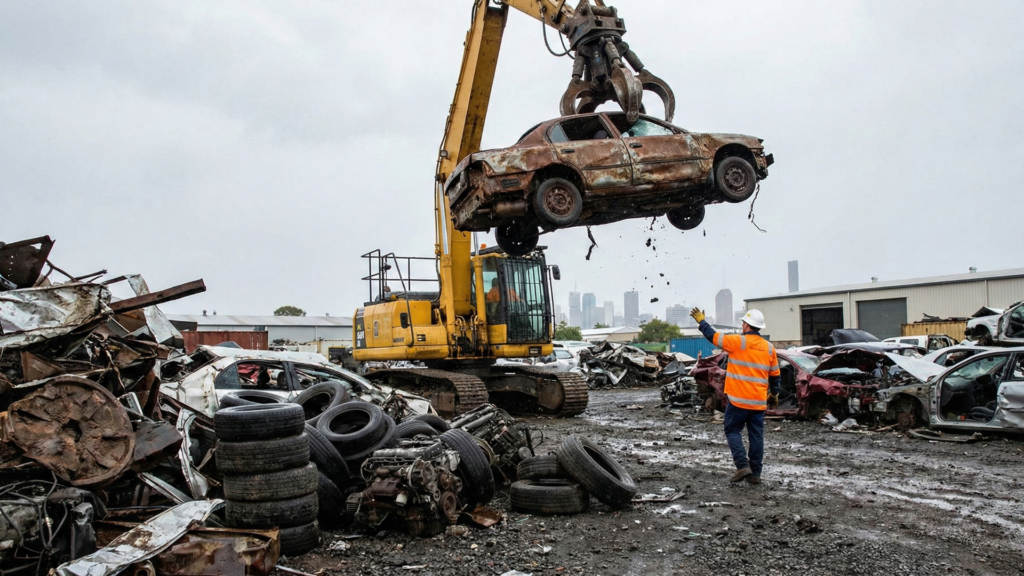
Aging, high-emission vehicles still circulating on Brisbane’s roads represent one of the region’s most stubborn barriers to genuine sustainability. Removing them efficiently, safely, and at scale is the work of professional car wreckers and the cash for cars model that funds it is one of the most underappreciated levers in South East Queensland’s clean transport strategy.
How Car Wreckers Reduce Brisbane’s Vehicle Emissions Problem
Brisbane’s air quality targets are directly undermined by the number of pre-emission-standard vehicles still registered and driven across the region. Vehicles manufactured before Australia’s ADR 79 emission standards came into full effect produce carbon monoxide, nitrogen oxides, and unburnt hydrocarbons at levels that modern vehicles simply do not. Many of these cars are concentrated in outer suburbs where cost-of-living pressures make vehicle upgrades difficult to prioritise.
This is where car wreckers providing genuine cash for cars payments serve a function that extends well beyond commercial convenience. By making it financially worthwhile for owners in suburbs like Inala, Durack, and Forest Lake to retire aging vehicles, professional car wreckers create a direct economic incentive for emission reduction that no government campaign alone can replicate.
The mechanism is straightforward and the impact is real:
- Removing pre-standard vehicles cuts per-kilometre emissions dramatically. A vehicle built before 2000 can produce three to five times the hydrocarbons of an equivalent modern car. Every one removed from active registration has a measurable effect on the region’s overall emissions profile.
- Cash for cars payments enable vehicle upgrades. Owners who receive a genuine cash for cars payout from licensed car wreckers are significantly more likely to invest those funds toward a newer, cleaner replacement accelerating fleet turnover in the segments of the market where it matters most.
- Car wreckers remove vehicles that would otherwise idle indefinitely. Without a financially viable exit, owners of unroadworthy or aging vehicles often retain registration rather than face disposal costs. Car wreckers offering free removal and immediate payment eliminate that barrier entirely.
- The cumulative regional effect is significant. Across Brisbane, Ipswich, the Gold Coast, and the Sunshine Coast, licensed car wreckers process thousands of end-of-life vehicles annually — representing a continuous, market-driven drawdown of the region’s oldest and least efficient fleet.
Car Wreckers and the Circular Economy: What Actually Happens to Your Vehicle
Sustainability in the automotive sector is not only about what comes out of an exhaust pipe. It is equally about the energy, water, and raw materials embedded in every vehicle manufactured and what happens to those resources at the end of a vehicle’s life. Professional car wreckers operating a rigorous dismantling process are, by any reasonable measure, one of Australia’s most active circular economy participants.
When a cash for cars collection takes place in Rocklea, Oxley, or anywhere across South East Queensland, the vehicle entering a licensed wrecking facility does not simply go to a crusher. It passes through a structured, sequential dismantling process designed to extract maximum value from every recoverable component:
- Parts harvesting for direct reuse. Alternators, starter motors, suspension components, brake assemblies, body panels, doors, bonnets, and interior trims are assessed, catalogued, and stored for resale. These parts extend the operational life of other vehicles on the road and displace the need for new parts manufacturing a process that carries its own substantial energy and resource cost.
- Fluid recovery and responsible disposal. Engine oil, coolant, brake fluid, power steering fluid, and transmission fluid are carefully drained before dismantling proceeds. These fluids, if left in abandoned vehicles or improperly disposed of, represent serious contamination risks to Brisbane’s river catchment system and surrounding groundwater. Licensed car wreckers ensure every fluid is captured and directed to appropriate recycling or disposal streams.
- Battery and hazardous material extraction. Lead-acid batteries are removed and processed through dedicated recycling channels. Air conditioning refrigerants are recovered using specialist equipment rather than vented to atmosphere. Airbag inflators which contain energetic materials are handled under specific safety protocols.
- Catalytic converter processing. Converters containing platinum, palladium, and rhodium are separated for precious metal recovery returning valuable materials to productive use rather than landfill.
- Steel and aluminium recycling at scale. The remaining body shell, chassis, and structural components are shredded and sorted by material grade. Recycling steel uses approximately 74 percent less energy than producing primary steel from iron ore. Aluminium recycling delivers energy savings of up to 95 percent compared to primary smelting. At the volumes processed by Brisbane’s car wreckers annually, these savings are substantial in aggregate.
Abandoned Vehicles: The Environmental Hazard Nobody Talks About
The environmental case for accessible car wreckers offering convenient cash for cars services is not only about active emissions. It is equally about the hazards created when end-of-life vehicles are not removed because when disposal is difficult, inconvenient, or costly, vehicles simply stay where they are.
A vehicle left to deteriorate in a driveway, yard, or vacant lot in suburbs like The Gap, Springfield, or Carole Park becomes an escalating environmental liability. The degradation timeline is well understood:
- Lead-acid batteries begin leaching lead compounds and sulphuric acid into surrounding soil within months of failure. Both are persistent soil contaminants with no natural remediation pathway.
- Fuel tanks on older vehicles corrode from the inside out. Residual petrol and diesel seeps into soil and, depending on proximity to drainage infrastructure, into stormwater systems feeding Brisbane’s waterway network.
- Engine oil and transmission fluid displaced by corrosion or seal failure pool beneath the vehicle and migrate into soil over time. A single litre of used engine oil can contaminate up to one million litres of groundwater.
- Cooling system fluids containing ethylene glycol are acutely toxic to wildlife and domestic animals, and persist in soil long after the source vehicle has been removed.
- Refrigerants from degrading air conditioning systems vent directly to atmosphere, contributing to ozone depletion at a per-kilogram impact far exceeding that of carbon dioxide.
Professional car wreckers offering 24/7 collection services across Brisbane, Ipswich, Toowoomba, and the broader South East Queensland region eliminate this risk before it materialises. The convenience of free, any-time removal is not a marketing feature it is the mechanism by which responsible vehicle disposal actually happens at scale. When it is easier to call car wreckers than to leave a vehicle in place, owners make the right choice.
Extending the Car Wreckers Network Across South East Queensland
Brisbane’s sustainability goals do not exist in isolation. The city’s environmental targets are embedded within a broader South East Queensland strategy that encompasses Ipswich, the Gold Coast, the Sunshine Coast, Toowoomba, and the rural corridors connecting them. A clean Brisbane requires clean surrounding regions and the cash for cars and vehicle removal infrastructure serving those regions needs to be as accessible as what is available in the inner city.
Reputable car wreckers operating across South East Queensland extend their collection coverage to ensure that vehicle owners in Redcliffe, Warwick, Gatton, and regional Darling Downs communities have the same access to responsible, paid vehicle disposal as residents of Paddington or New Farm. This geographic consistency matters because end-of-life vehicles do not concentrate in urban centres they are distributed across the full footprint of the region, and the environmental impact of leaving them in place is the same regardless of postcode.
For rural and semi-rural property owners, the cash for cars model offered by professional car wreckers is often the only economically rational disposal pathway. Towing costs from remote properties can be prohibitive without a free collection service and without that service, vehicles stay put.
