Get Support
040-388-4597
-
 By: admin
 - 0 Comments
 By:
By: Beyond battery replacement, electric vehicles present systemic repair cost challenges that internal combustion engine vehicles simply do not. These are structural to the technology and the regulatory environment surrounding it, and they apply regardless of make or model.
High-voltage certification requirements eliminate most independent repairers. Working on electric vehicle drivetrain systems anything involving the traction battery, inverter, electric motor, or DC charging components requires mechanics to hold specialised high-voltage electrical safety certification. This training is expensive, time-intensive, and carries ongoing compliance obligations. The result is a dramatically smaller pool of qualified technicians, concentrated in metro areas and commanding significantly higher hourly rates. For owners in Toowoomba, Gatton, or regional Queensland, access to qualified EV mechanics is limited or nonexistent, forcing reliance on dealerships with higher labour costs and extended wait times.
Proprietary diagnostic software creates artificial repair barriers. Manufacturers tightly control access to the diagnostic software required to interface with EV battery management systems, motor controllers, and charging infrastructure. Unlike traditional diagnostic systems used in combustion vehicles which any independent workshop can access EV-specific diagnostics are often restricted to authorised dealerships. This eliminates competitive pricing on labour and extends repair timelines, as independent mechanics capable of performing the physical work are unable to complete the software validation required to clear fault codes or recalibrate replaced components.
Parts availability is constrained by low production volumes. Electric vehicles represent a small fraction of the national fleet, and many models sold in Australia are parallel imports or low-volume releases. Replacement parts for traction batteries, inverters, and electric motors are not held in local inventory. Wait times of several months for critical components are routine. During this period, the vehicle remains inoperable and for most owners, financing or insuring an undriveable car while waiting for parts is not viable.
Software locks enforce component pairing. Many EV manufacturers implement cryptographic pairing between the battery management system, inverter, and vehicle control unit. Replacing a failed component often requires the new part to be software-authenticated by the manufacturer before the vehicle will operate. This cannot be done by independent workshops, forcing owners back to dealerships for what is, in effect, a software unlock charged at premium rates even when the physical repair was completed elsewhere.
Together, these factors create an environment in which even minor EV repairs become prohibitively expensive relative to the vehicle’s value and when major repairs like battery replacement are required, car wreckers offering cash for cars become the only economically rational exit.
Minor Collisions, Total Write-Offs: How Insurance Declares EVs Uneconomical
In a conventional vehicle, a low-speed rear-end collision typically results in bumper and tailgate damage repairable for a manageable sum. In many electric vehicles, the high-voltage traction battery is structurally integrated into the floor pan, running the full length of the passenger compartment. Any impact that deforms the underside of the vehicle even slightly has the potential to compromise battery cell integrity.
The risk assessment calculation insurance assessors perform is straightforward: if there is any possibility that battery cells have been mechanically stressed or punctured, the vehicle cannot be safely returned to service without a full battery inspection or replacement. Because battery inspection requires complete disassembly a process costing thousands in labour alone and because any detected damage mandates full battery replacement, insurers write off the vehicle rather than proceed.
This creates a scenario unique to electric vehicles: cosmetically minor accidents producing statutory total losses. A rear-end collision that would result in a modest repair bill on a conventional sedan can produce a complete write-off on an EV not because of visible damage, but because of the unquantifiable risk embedded in the battery pack beneath.
These write-offs flood the market with EVs that are mechanically sound apart from the potential battery compromise. Car wreckers accept these vehicles regardless of write-off status, offering cash for cars based on the undamaged components body panels, glass, interior trim, electric motors, inverters, and the substantial weight of recyclable steel and aluminium in the chassis.
The Logistical Challenge of Removing Dead EVs And Why 24/7 Car Wreckers Matter
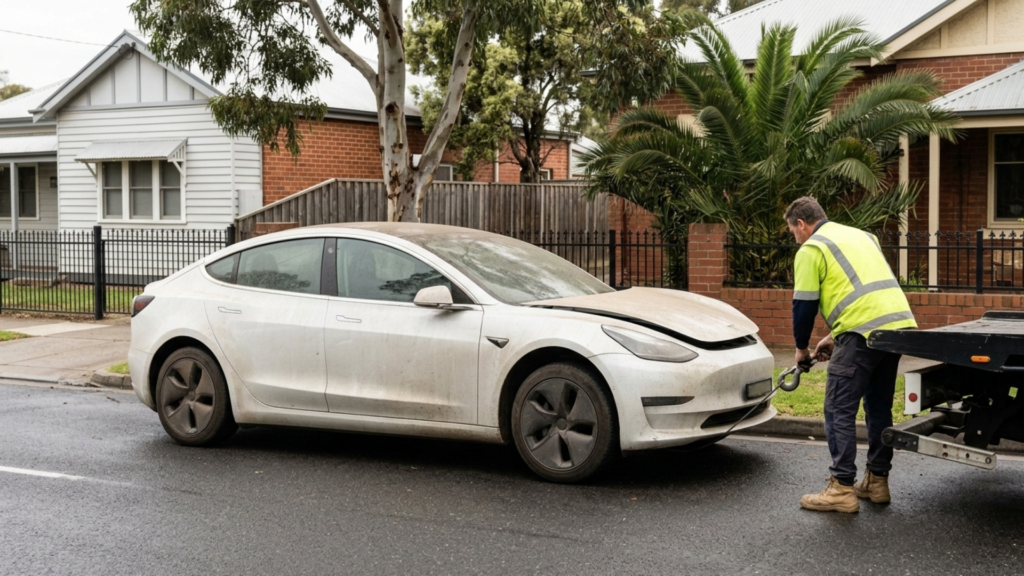
When an electric vehicle suffers a complete electrical failure, it does not simply become a non-runner it often becomes physically immovable without specialised equipment. Many EVs electronically lock their drive wheels when the low-voltage auxiliary battery fails or when the high-voltage system enters a fault state. Unlike a conventional automatic transmission that can be shifted to neutral manually, an EV in a fault-locked state cannot be pushed, winched using standard methods, or towed with driven wheels on the ground.
For an owner with a dead EV stuck in a driveway in The Gap, Redcliffe, or Everton Park, this presents an immediate logistical problem. Standard towing services may refuse the job due to liability concerns or lack of appropriate equipment. Removing the vehicle requires a flatbed truck, wheel skates, or a tilt-tray capable of loading without rolling the wheels equipment not universally available across Brisbane’s towing sector.
Professional car wreckers operating 24/7 collection services across South East Queensland maintain the specialised equipment required to extract fault-locked EVs from residential garages, basement car parks, and tight street parking. This equipment access combined with technicians trained in high-voltage vehicle handling makes car wreckers the most reliable option for owners who need a dead EV removed urgently and are seeking cash for cars rather than an expensive tow to a dealership for a repair quote they already know they cannot afford.
What Happens to EVs at Car Wreckers And Why They Retain Strong Cash for Cars Value
Electric vehicles entering licensed car wreckers facilities in Brisbane and South East Queensland undergo a different dismantling process than conventional vehicles, driven by the unique value and hazards their components present.
High-voltage battery handling and recovery. Traction batteries are carefully disconnected, assessed for remaining capacity, and processed through dedicated recycling channels. Even degraded batteries contain significant quantities of valuable materials lithium, cobalt, nickel, and manganese all with strong commodity value and increasingly robust recycling infrastructure in Australia. Batteries assessed as having sufficient remaining capacity may be refurbished for second-life applications such as stationary energy storage.
Electric motor and inverter salvage. EV motors contain rare earth permanent magnets materials that are expensive and supply-constrained. These components are harvested for recycling or direct reuse. Inverters and power converters, if undamaged, are high-value parts for repair of other EVs and attract strong secondhand market prices.
Body and structural components retain full value. Aluminium-intensive construction in many EVs makes body shell recycling more valuable per kilogram than conventional steel-bodied vehicles. Undamaged panels, glass, and interior components are catalogued for resale as they would be for any vehicle entering a wrecking facility.
This combination of battery material value, rare earth content, and lightweight structural materials means that EVs written off due to repair costs often attract cash for cars offers from car wreckers that are stronger than owners expect particularly for larger or premium models where material mass and rare earth content are highest.
Frequently Asked Questions
Do Brisbane car wreckers accept electric vehicles for cash for cars?
Yes. Licensed car wreckers across Brisbane and South East Queensland accept all electric and hybrid vehicles regardless of condition, age, or write-off status. Cash for cars is paid based on salvageable components, battery material value, and recyclable structural materials.
How much cash for cars can I expect for a battery-failed EV?
Payouts vary based on vehicle size, remaining component condition, and current commodity prices for battery materials and rare earth metals. Larger EVs and premium models typically attract higher offers due to greater material mass and component value.
Can car wreckers collect a dead, immobile EV?
Yes. Reputable car wreckers maintain specialised equipment for extracting fault-locked EVs that cannot be rolled or towed conventionally. Collection is provided at no cost across Brisbane, Ipswich, Gold Coast, and surrounding South East Queensland regions.
Will I receive less cash for cars if my EV is an insurance write-off?
Write-off status does not reduce the material and component value car wreckers assess. Body panels, motors, inverters, and battery materials retain their value regardless of the vehicle’s registration or insurance history.
How quickly can car wreckers collect an EV in Brisbane?
Established car wreckers offer same-day or next-day collection as standard, with 24/7 availability for urgent removals. The process typically completes within 24 hours from initial enquiry to cash for cars payment.
What makes EV repairs more expensive than conventional car repairs?
EV repairs require specialised high-voltage certification for technicians, proprietary diagnostic software restricted to dealerships, longer parts lead times, and software authentication for replaced components all of which drive costs significantly higher than equivalent conventional vehicle repairs.
